


Page 15 - hypertension_newsletter
P. 15
REFLECTIONS
                                                                                                                   Hypertension
     Hypertension Global Newsletter #10 2026


     Artificial intelligence in cardiovascular medicine: Focus on hypertension.                                    Hypertension
     Varzideh F, et al. Hypertension. 2026 Jun;83(6):e26094.

     Despite decades of pharmaceutical advancements, over one billion adults globally are affected by high BP, and successful
     control rates remain low. Traditional clinical medicine treats BP as a static, generalized threshold, failing to account for the
     fact that it is a highly dynamic physiological variable, constantly influenced by an individual’s genetics and behaviors. Because
     traditional care relies on episodic office visits, patients frequently experience delayed diagnoses, unrecognized (“masked”)
     hypertension, and trial-and-error prescribing that leads to poor medication adherence. To overcome the limits of human
     cognition and “one-size-fits-all” guidelines, AI has emerged as a disruptive tool capable of digesting massive, multidimensional
     datasets to shift hypertension management from a reactive approach to a highly predictive, personalized, and proactive model.

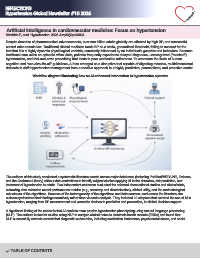
                     Workflow diagram illustrating how an AI-enhanced intervention in hypertension operates


     The authors of this study conducted a systematic literature search across major databases (including PubMed/MEDLINE, Embase,
     and the Cochrane Library) without date restrictions to identify original studies applying AI to the detection, risk prediction, and
     treatment of hypertension in adults. Two independent reviewers evaluated the selected observational studies and clinical trials,
     extracting data related to model performance metrics (e.g., accuracy and discrimination), clinical utility, and the methodological
     robustness of the algorithms. Because of the heterogeneity of the algorithms and data sources used across the literature, the
     authors synthesized their findings narratively rather than via meta-analysis. They included 10 chapters that covered the use of AI in
     hypertension, ranging from BP measurement and wearable devices to prediction and prevention, to clinical decision support.

     A significant finding of the review is that AI enables more precise hypertension phenotyping using natural language processing
     (NLP). The authors looked at studies using NLP to analyze clinical notes in electronic health records (EHRs) and found that
     NLP successfully extracts context that diagnostic codes miss, including medication intolerance, psychosocial stress, and social


          TABLE OF CONTENTS

