


Page 9 - hypertension_newsletter
P. 9
REFLECTIONS
                                                                                                                   Hypertension
     Hypertension Global Newsletter #10 2026


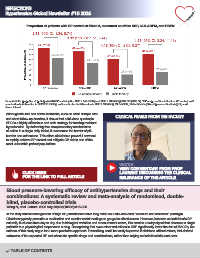
                 Proportion of patients with BP control at Week 8, measured as office SBP, 24 h-ABPM, and HBPM     Hypertension


     Bars show the proportion of participants with BP control (office SBP < 140 mmHg and DBP < 90 mmHg) with OR (95% CI). *BP response was defined as BP control, and/
     or reduction from baseline in SBP ≥ 20 mmHg, and/or reduction from baseline in DBP ≥ 10 mmHg. 24 h-ABPM, 24 h ambulatory blood pressure monitoring; CI, confi-
     dence interval.

     Although this trial had some limitations, such as small sample size
     and short follow-up duration, it shows that a full-dose quadruple   CLINICAL PEARLS FROM THE FACULTY
     SPC is a highly efficacious and safe strategy for treating resistant
     hypertension. By delivering four complementary mechanisms
     of action in a single daily tablet, it overcomes the barrier of pill-
     burden non-adherence. This offers clinicians a powerful new tool
     to rapidly achieve BP control and mitigate CV risk in one of the
     most vulnerable patient populations.


                                                                          WATCH
                                                                          VIEW COMMENTARY FROM PROF.
               CLICK HERE                                                 LAURENT DISCUSSING THE CLINICAL
               FOR THE LINK TO FULL ARTICLE                               RELEVANCE OF THE ARTICLE.


     Blood pressure-lowering efficacy of antihypertensive drugs and their
     combinations: A systematic review and meta-analysis of randomised, double-
     blind, placebo-controlled trials.
     Wang N, et al. Lancet. 2025 Aug 30;406(10506):915-925.

     In the daily clinical management of high BP, practitioners have long relied on a trial-and-error “measure and reassess” paradigm.
     Clinicians typically prescribe a medication and monitor serial readings to gauge its effectiveness. However, because an individual’s BP
     naturally fluctuates from day to day due to biological variation and measurement errors, this creates a noisy signal that obscures a single
     patient’s true physiological response to a drug. Recognizing that even minor reductions in SBP significantly lower the risk of MACEs, the
     authors of this study argue for a more predictive approach. Prescribing could be vastly improved if clinicians utilized robust, trial-derived
     estimates of the expected BP reductions for specific drugs and combinations, rather than relying on individual trial-and-error.


          TABLE OF CONTENTS

