


Page 6 - hypertension_newsletter
P. 6
REFLECTIONS
                                                                                                                   Hypertension
     Hypertension Global Newsletter #10 2026


     TREATMENT                                                                                                     Hypertension


     New drug therapies for hypertension.
     Azizi M, et al.  Lancet. 2026 Mar 7;407(10532):1014-1028.
     Although many low-cost, effective antihypertensive drugs are widely available today, a global gap persists in achieving target
     BP levels. This is largely driven by poor medication adherence, therapeutic inertia, and rising rates of complex multimorbidities.
     Furthermore, the intricate, multifactorial pathophysiology of hypertension means that conventional drug classes often fall short of
     addressing all underlying mechanisms, leaving patients with resistant hypertension or CKD highly vulnerable. To overcome these
     hurdles, the medical community needs novel pharmacological agents designed to target entirely new physiological pathways.

     The authors of this review conducted a systematic literature search of databases such as MEDLINE and PubMed, focusing on
     articles and RCTs published between January 2015 and September 2025. The objective was to evaluate the efficacy, safety, and
     clinical outcomes of newly emerging antihypertensive drug classes that modulate systems beyond traditional targets, including
     RNA interference, aldosterone synthase, the endothelin system, and natriuretic peptides.

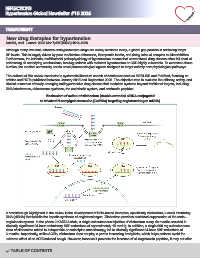
                             Mechanism of action of zilebesiran (double-stranded siRNA conjugated
                          to trivalent N-acetylgalactosamine [GalNAc] targeting angiotensinogen mRNA)


     A breakthrough highlighted in the review is the development of RNA-based therapies, specifically zilebesiran, a small interfering
     RNA (siRNA) that inhibits the hepatic synthesis of angiotensinogen. Zilebesiran provides sustained suppression of the renin–
     angiotensin system. In the phase 2 KARDIA trials, a single subcutaneous injection of zilebesiran every six months resulted in
     clinically significant 24-hour ambulatory SBP reductions of approximately 15 mmHg. In addition, a single 600 mg subcutaneous
     dose of zilebesiran added to indapamide or amlodipine monotherapy, led to clinically significant 24-hour SBP reductions at
     3 months. Importantly, unlike ACEis, zilebesiran does not play a part in increasing bradykinin, which helps patients avoid the
     adverse effect of an ACEi-induced cough. However, because it prevents the increase of all angiotensin peptides, it may not offer


          TABLE OF CONTENTS

