


Page 5 - hypertension_newsletter
P. 5
REFLECTIONS
                                                                                                                   Hypertension
     Hypertension Global Newsletter #10 2026


     The statement emphasizes that the clinical and economic benefits of SPCs far outweigh their limitations. Clinical data demonstrate
     that initiating treatment with a two-drug SPC yields faster, more sustained BP control and better long-term medication adherence
     than the traditional stepped-care approach. For example, combining two agents with complementary mechanisms results in about
                                                                                                                   Hypertension
     five times larger reduction in BP compared with doubling the dose of a single drug. The committee highlights that combination
     regimens should ideally pair a renin-angiotensin
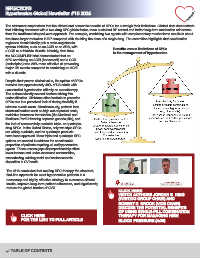
     system inhibitor, such as an ACEi or an ARB, with                Benefits versus limitations of SPCs
     a CCB or a thiazide diuretic. Notably, data from                 in the management of hypertension
     the ACCOMPLISH trial demonstrated that an
     SPC combining an ACEi (benazepril) and a CCB
     (amlodipine) was 20% more effective at preventing
     major CV events compared to combining an ACEi
     with a diuretic.

     Despite their proven clinical value, the uptake of SPCs
     remains low; approximately 40% of US adults with
     uncontrolled hypertension still rely on monotherapy.
     The authors identify several barriers driving this
     underutilization. Clinicians often hesitate to prescribe
     SPCs due to a perceived lack of dosing flexibility if
     adverse events occur. Simultaneously, patients face
     structural barriers such as high out-of-pocket costs,
     restrictive insurance formularies (like Medicaid and
     Medicare Part D favoring separate generic pills), and
     the lack of commercially available triple- or quadruple-
     drug SPCs. In the United States, only two triple SPCs
     are widely available, and no quadruple products
     have been approved. More triple and quadruple SPC
     options are needed to address the considerable
     proportion of patients requiring ≥3 antihypertensive
     agents. These access gaps disproportionately affect
     lower-income and under-resourced communities,
     exacerbating existing racial and socioeconomic
     disparities in CV health.

     The AHA concludes that making SPC therapy the standard,
     first-line approach for most hypertensive patients is a
     necessary and highly effective strategy to overcome clinical
     inertia, improve long-term patient adherence, and significantly
     reduce the global burden of CVD.
                                                                         CLICK HERE
                                                                         WATCH AUTHORS JORDAN B. KING
                                                                         (WRITING GROUP CHAIR) AND
                                                                         ROBERT D. BROOK (VICE CHAIR)
                                                                         DISCUSS THE POTENTIAL BENEFITS
                                                                         OF USING SINGLE-PILL COMBINATION
              CLICK HERE                                                 THERAPY FOR MANAGING HIGH
              FOR THE LINK TO FULL ARTICLE                               BLOOD PRESSURE (4:30)


          TABLE OF CONTENTS

